Linear movement can be created in several ways, and the most sophisticated solution is not always necessary. Lead Screws remain relevant in industrial machinery because they can provide straightforward rotary-to-linear motion for positioning, adjustment, lifting, and controlled movement applications.
The right choice depends on understanding what the machine actually needs.
Lead Screw Characteristics That Matter
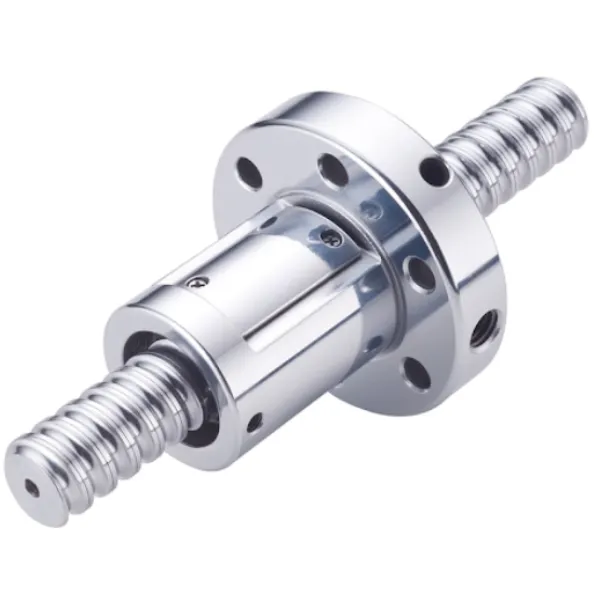
A lead screw typically works through sliding contact between the screw and nut. This differs from rolling-element screw technologies and influences efficiency, friction, wear, and operating behaviour.
Key parameters include screw diameter, lead, thread geometry, nut material, load capacity, speed, lubrication, and required positioning accuracy.
The lead determines how far the nut travels for each screw revolution. A larger lead can increase linear travel per revolution, while a smaller lead may be preferred where finer movement is required.
Lead Screw and Ballscrew Selection
Both technologies convert rotary movement into linear travel, but they behave differently.
Ballscrews generally use recirculating rolling elements, which can provide high efficiency and suitability for demanding precision motion. Lead screw assemblies use sliding contact and may suit applications where simplicity, controlled adjustment, moderate speed, and application-specific cost considerations are more important.
The correct choice depends on:
- Required positioning accuracy
- Operating speed
- Axial load
- Duty cycle
- Efficiency expectations
- Back-driving considerations
- Maintenance requirements
- Available budget
There is no universal winner because the application determines which characteristics matter most.
Common Selection Mistakes
One mistake is choosing a screw based only on diameter. Two screws with similar dimensions can behave differently because of lead, thread design, nut configuration, material, and loading conditions.
Another mistake is ignoring duty cycle. A mechanism adjusted occasionally has very different operating requirements from an axis cycling throughout a production shift.
Environmental conditions also deserve attention. Dust, debris, heat, moisture, and industrial contaminants can influence lubrication and wear.
Consider the Entire Mechanical Axis
Motor torque, screw lead, guideway friction, load, acceleration, bearings, couplings, and mounting accuracy all interact.
A poorly aligned system can increase friction and reduce the expected service performance of the screw and nut. Likewise, an undersized motor may struggle even when the screw itself is correctly selected.
For machine builders and maintenance teams in Bengaluru's manufacturing sector, evaluating the complete mechanism helps avoid component-by-component decisions that create compatibility problems later.
Making a Practical Selection
OLE Automation Inc supports industrial engineering and motion-control requirements in Bengaluru. When assessing Lead Screws, engineering teams can begin by documenting load, stroke, speed, positioning requirement, mounting orientation, operating frequency, and environmental conditions.
These parameters make supplier discussions more productive and help narrow the available options.
A lead screw works best when its characteristics match the real operating profile. Rather than selecting from a dimensional drawing alone, manufacturers can evaluate how the screw will behave after installation, under load, and throughout repeated machine operation.
Keywords